Asta's Story
The Foundation: Classical Excellence in Lithuania
Asta's artistic journey began at the prestigious M.K. Čiurlionis Art College in Vilnius, where from age eleven to eighteen, she received the kind of comprehensive classical training that has become increasingly rare in contemporary art education. The rigorous curriculum—encompassing everything from charcoal drawing and etching to oil painting and mixed media—was complemented by inspiring working holidays in the artist village Nida. Perhaps most significantly, her teachers imparted not merely technical skills but what she describes as the art of living—and philosophical depth that would later infuse her mature work with profound meaning.
Her collection of early works, some of them now elegantly framed in Van Gogh-style frames, reveals an artist already grappling with complex emotional and symbolic content. These pieces demonstrate not just technical proficiency but an innate understanding of how color and form can convey psychological states—a quality that would become central to her artistic identity.
Professional Evolution: From Cultural Heart to Technical Innovation
Following six years at the Art Institute, Asta entered the vibrant cultural landscape of Vilnius, creating posters and scenography for large-scale productions, including poetry events. Her multidisciplinary approach extended beyond the visual arts—she designed and created her own clothing, embodying the total aesthetic vision that would characterize her later work.
Her transition to graphic design at Vilnius Technical University marked a crucial evolution. Here, she mastered digital techniques and calligraphy, expanding her traditional foundation into contemporary media. This period of technical experimentation would prove invaluable, as seen in her current blossom series, where sophisticated linear play reveals the influence of her graphic design background in a refined play of lines.
The Provence Revelation: Symbolic Transformation
The 2010 move to Maastricht with her partner, pianist Jeroen Riemsdijk, marked not just a geographical shift but an artistic renaissance. Her transformative experience in St. Rémy-de-Provence—the same landscape that inspired Van Gogh—resulted in a pivotal body of work that now hangs in her home. These paintings, rich with symbolism typical of her mature style, represent a breakthrough moment where her classical training, professional experience, and personal philosophy converged into a distinctive voice.
The Provence works demonstrate her ability to layer meaning within visually accessible imagery. The symbolism she employs is neither heavy-handed nor obscure but emerges naturally from her deep engagement with the landscape and her own psychological processes.
Another item she considered part of her precious private collection is an acrylic painting depicting her playfully erotic interpretation of the Vieille Port in Marseille. What appears to be a play of hallucinating Arabic arabesques.
Technical Mastery Across Media
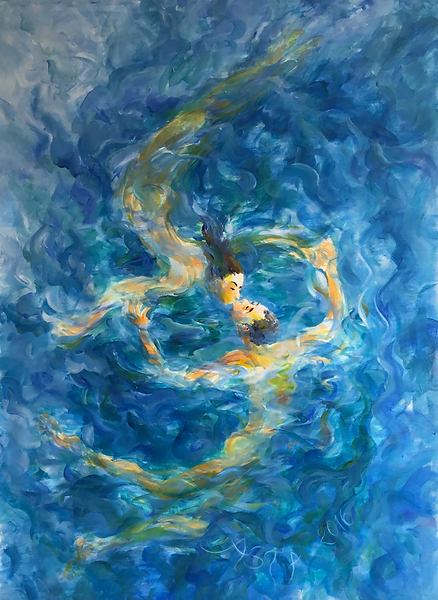
Asta's current practice, primarily in acrylics, showcases remarkable versatility. Her virtuosic handling is perhaps most evident in her quick sketches—such as the fluid, captured moment of "The Kiss in the Swimming Pool"—where years of training allow her to distill complex emotional content into seemingly effortless gestures. These studies reveal an artist completely in command of her medium, able to shift seamlessly between detailed realism and expressive abstraction.
Her still life studies, exemplified by the meticulously rendered cactus painting, demonstrate her continued engagement with the classical tradition while bringing contemporary psychological insight to bear on humble subjects. The precision of observation and the subtle modulation of light and shadow speak to an artist who has never stopped learning from direct observation.
Abstract Investigations: "Kingdom" and Beyond
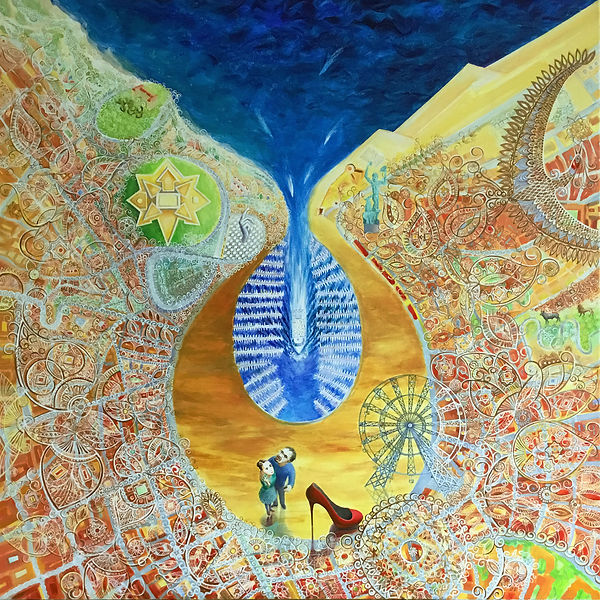
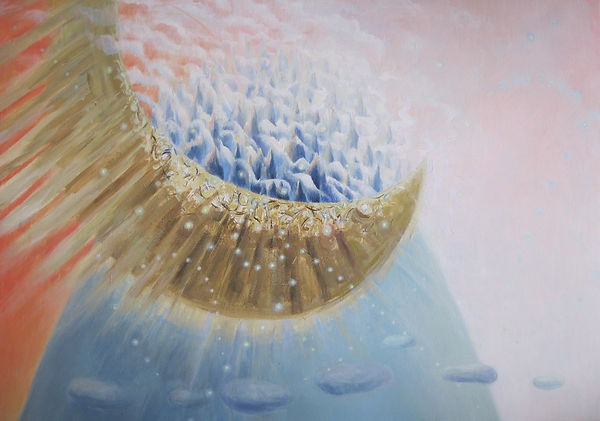
Perhaps most intriguing is Asta's abstract work, including the enigmatic "Kingdom," which reveals an artist unafraid to abandon representation entirely when pure form and color better serve her expressive needs. These works suggest an ongoing dialogue between her classical foundation and contemporary concerns, resulting in compositions that feel both timeless and urgently contemporary.
The Private Collection: Baltic Folklore and Contemporary Life
Among her most personal works is the series featuring herself and her husband, where Baltic folklore traditions merge with primitivism and contemporary portraiture. These paintings, drawn from her extensive private collection, reveal an artist working through questions of cultural identity, partnership, and the meaning of home. The folkloric elements are not mere decorative additions but integral to works that explore the complexity of living between cultures.
The Shamanic Dimension: Art as Healing Practice
Asta's work emerges from a practice rooted in meditation, lucid dreams, and prophetic dreams. She approaches painting as a form of deep listening—to inner states, to the material itself, to what wants to emerge. The resulting works carry a particular quality of presence, a quiet intensity that viewers often find both calming and energizing. This isn't about explicit spiritual content but rather about the quality of attention brought to the creative process—something that seems to transmit itself through the accumulated gestures of paint on canvas.
Her studio in Maastricht is open for serious collectors and curators by appointment.