Asta's Story
The Foundation: A Classical Training in Lithuania
Asta's training began at the M. K. Čiurlionis School of Art in Vilnius, where she studied from the age of eleven to eighteen. Alongside a broad grounding in drawing, printmaking, painting and mixed media, working periods in Nida became an equally important part of her formation. Asta remembers these years not only for the technical discipline they provided, but also for teachers who approached art as part of a wider way of seeing and living.
A number of works from these early years have remained in her private collection. Seen today, they already reveal an interest in emotional atmosphere, symbolic detail and the expressive possibilities of colour and form — qualities that would grow increasingly central to her work.
The Vilnius Years: Design and Stage Work
After six years of study at the Vilnius Art Institute, Asta began working within the cultural life of the city, creating posters and scenographic designs for stage productions and cultural events, including poetry evenings. Her interests extended beyond graphic and stage design; she also designed and made her own clothing, reflecting a broad engagement with colour, form and composition.
She later worked as a graphic designer at Vilnius Technical University, where she expanded her practice into digital media and calligraphy. This experience added another layer to her earlier training and remains visible in her painting today. In the blossom series in particular, a sense of rhythm, repetition and ornamental structure reflects the lasting influence of that design work.
The Provence Paintings
Asta’s move to Maastricht in 2010 opened a new period in her work. A journey to Saint-Rémy-de-Provence, with its intense landscape and long artistic history, became particularly important. The paintings that grew from it mark a moment in which her earlier training, graphic sensibility and personal way of seeing began to come together in a more explicitly symbolic language.
In the Provence works, recognisable places and experiences are transformed through memory, association and imagination. Figures, landscapes and unexpected objects coexist within compositions that remain visually direct while carrying several layers of meaning. Much of the symbolism that would come to define Asta’s work is already present here, emerging naturally from her engagement with place, relationships and inner life.
One work in Asta's private collection, an acrylic painting inspired by the Vieux-Port in Marseille, turns the scene into a playfully erotic composition in which architectural and ornamental forms dissolve into a dense, almost hallucinatory rhythm of arabesques.
Across Media
Asta's current practice centres on acrylic painting, alongside drawing and spontaneous studies. In quick works such as The Kiss in the Swimming Pool, years of training show in the economy of gesture and in an ability to capture movement, intimacy and atmosphere with very few means.
These studies sit beside her more detailed paintings and reveal the breadth of her visual language, from close observation to freer, more expressive handling.
Home and Belonging: Baltic Folklore and Contemporary Life
Among Asta's most personal works are paintings of herself and her husband, in which Baltic folkloric references meet contemporary portraiture. These works draw on shared experience, memory and the imagery of home, joining intimate relationships to motifs rooted in Lithuanian culture.
Folkloric elements often carry much of the image's emotional weight, adding layers of association around partnership, belonging and the experience of living between cultures. In this group of works, private memory and cultural inheritance are closely intertwined.
Abstraction: Kingdom and After
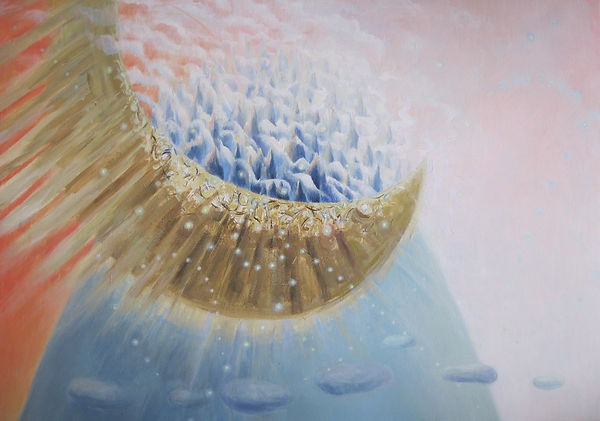
Although Asta's practice is predominantly figurative, she has also explored abstraction in works such as Kingdom. These paintings give greater autonomy to colour, rhythm and organic form, and open up another aspect of the same sensibility that shapes her figurative painting.
Rather than forming a separate direction, the abstract works extend her interest in pattern, movement and symbolic association into a more open pictorial language.
Inner Sources: Dream, Ritual and Healing
Meditation, lucid dreams and intuitive imagery form an important part of Asta's creative process. She has also experienced dreams that she herself understands as anticipatory or prophetic, and these can become sources for later images and associations.
Painting for Asta often begins with a form of deep attention: to a person, a situation, an inner state, or to what gradually emerges during the making of the work. Some paintings take shape around moments of transition, loss, recovery, love or hope, giving them an almost ritual quality.
This shamanic dimension remains understated in the work itself. It is present in the concentration with which the paintings are made, in their symbolic language and in Asta's belief that an image can carry emotional energy and strengthen a sense of connection.
Studio visits in Maastricht and Vilnius can be arranged by appointment.